Case study 25 / 37
ArchitectFlow
Design a system's architecture, data model, API and UI as one versioned document, check it with deterministic rules, and generate an implementation prompt from the exact saved revision.
- Status
- Experimental
- Period
- 2026
- Domain
- Web · AI
- Language
- Python
- Last push
- 26 OCT 2026
- License
- MIT OR Apache-2.0
- Source of claims
- README.md, docs/ARCHITECTURE.md, docs/LIMITATIONS.md, CHANGELOG.md, apps/api/architectflow/routes/auth.py, apps/api/architectflow/main.py, .github/workflows/ci.yml; release-gate verification 2026-10
01/The problem
Diagrams drift from what gets built, AI assistants silently rewrite designs, and the prompt handed to a coding agent is usually assembled from stale chat history.
02/The system
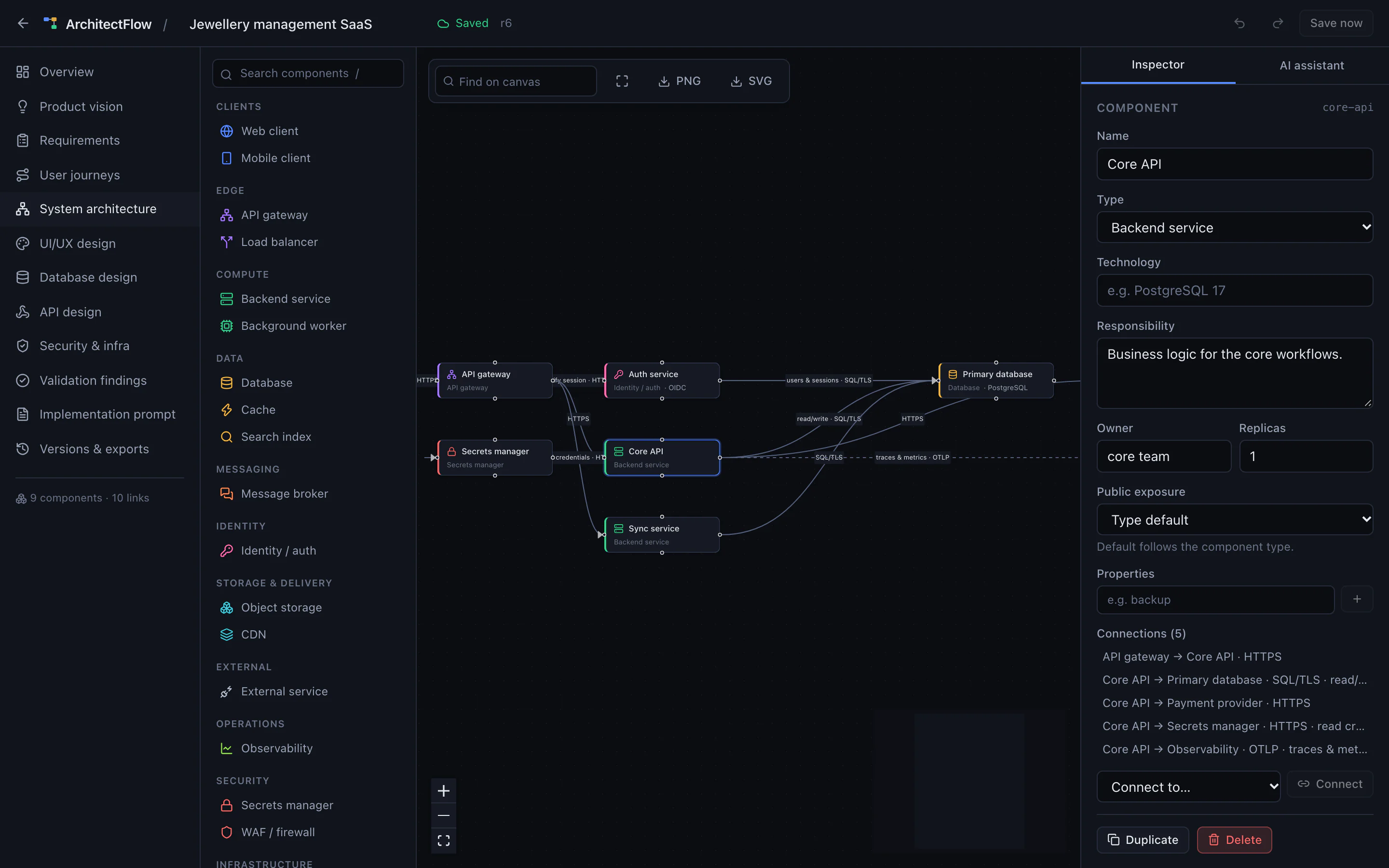
A Next.js and FastAPI app backed by PostgreSQL. Every change (manual edit, import, restore or AI proposal) passes one integrity gate and becomes an immutable revision. AI output arrives as a change set that is diffed and validated before anyone applies it, and each generated prompt records the revision it came from and is marked OUTDATED when the design moves on.
- Next.js UI to Next.js server
- Next.js server to FastAPI
- FastAPI to Change sets
- Change sets to AI providers
- Change sets to Integrity gate
- FastAPI to Integrity gate
- FastAPI to Validation rules
- FastAPI to PostgreSQL
03/Implementation
- 01Twelve workspaces share one typed document: requirements, an architecture graph with 18 component types, database entities with foreign keys and indexes, API endpoints mapped to columns, and UI theme tokens and pages.
- 02An untrusted-input pre-check and an integrity gate reject definite defects (duplicate ids, dangling edges, foreign keys to missing columns, NaN, NUL or over-deep JSON) with a 422 and a dotted field path. A failing document is never stored.
- 03Deterministic validation with 94 rule ids, keeping structural errors separate from recommendations that quote evidence and a fix.
- 04AI providers: a labelled offline example mode (the default), OpenAI-compatible Chat Completions and Anthropic Messages. Provider failures map to 502, 503, 504, 429 or 422 and never change the design.
- 05A prompt generator with 8 modes × 3 agent presets, and exports to Mermaid, PlantUML, C4, ERD, PostgreSQL DDL and OpenAPI 3.1.
04/Engineering
One document, not linked revisions
References from UI to endpoint to entity to data store are validated together. The trade-off is that every save writes the whole document, bounded by a 2 MB request limit.
AI output is a proposal
A change set is applied to a copy, run through the same integrity gate and shown as a diff with findings. Large destructive sets (at least 3 components and 40% removed) need explicit confirmation.
Session security
Argon2id passwords, HttpOnly, Secure, SameSite=Lax session cookies, a CSRF header on writes, rate-limited login, and a body limit enforced while reading, including chunked bodies without Content-Length.
05/Interface
Real screenshots of the running software. Captions state the data shown.
06/Tech stack
- Next.js 16
- React 19
- React Flow
- FastAPI
- Python 3.12
- SQLAlchemy
- PostgreSQL
- Alembic
- Vitest
- Playwright
- Docker
07/Result
Verified outcomes
- Release-gate verification (2026-10): 172 API tests on PostgreSQL, 48 Vitest tests and 20 Playwright end-to-end specs passed; Alembic upgrade → downgrade → upgrade verified.
- Docker images and a Compose file; the live AI path was verified against a local OpenAI-compatible model.
Known limitations
- Single-owner projects: read-only share links, but no editor roles or real-time co-editing.
- Rate limits are in memory per API process; the canvas is built for screens of 1024 px and wider.
- Real model output quality is not evaluated; diagrams are export-only.
08/Links
Related work
Market tracker
Puffer →
A full-stack stock tracker with watchlists, market search and AI-written news digests delivered by background jobs.
Open source · In development
LLM provider control center
ModelHarbor →
A self-hosted dashboard for every configured LLM provider: live health and latency per model, task-aware routing with live failover, and a usage-cost ledger.
Open source · In development
Agent skill · video renderer
Animation Ad →
An agent skill that reads a product's source, writes a storyboard and renders a real animated ad locally: motion graphics, characters or low-poly 3D, with voice, music and captions.
Private · Working build
Next case study
SLM →