Case study 33 / 37
ModelHarbor
A self-hosted dashboard for every configured LLM provider: live health and latency per model, task-aware routing with live failover, and a usage-cost ledger.
- Status
- In development
- Period
- 2026
- Domain
- AI · Web
- Language
- TypeScript
- Last push
- 26 OCT 2026
- License
- MIT
- Source of claims
- README.md, CHANGELOG.md, docs/PRODUCTION_READINESS.md, server/src/index.ts, server/test/setup.ts, .github/workflows/ci.yml; mock-mode server run from a fresh clone 2026-10-25
01/The problem
Teams running several LLM providers cannot see which models are up right now, routing lives in if-statements nobody trusts, and the monthly invoice is a surprise.
02/The system
A zero-framework Node server and a Vite + React dashboard. Each model is health-checked on a TTL; each task type has a ranked pool of models; a request that fails at call time fails over to the next candidate, and every attempt is recorded as a usage event with token counts and cost. A deterministic mock provider runs the whole thing with no API keys.
- Dashboard to api.ts
- api.ts to health.ts
- api.ts to router.ts
- api.ts to execute.ts
- health.ts to Providers
- router.ts to health.ts
- execute.ts to Providers
- execute.ts to costStore.ts
03/Implementation
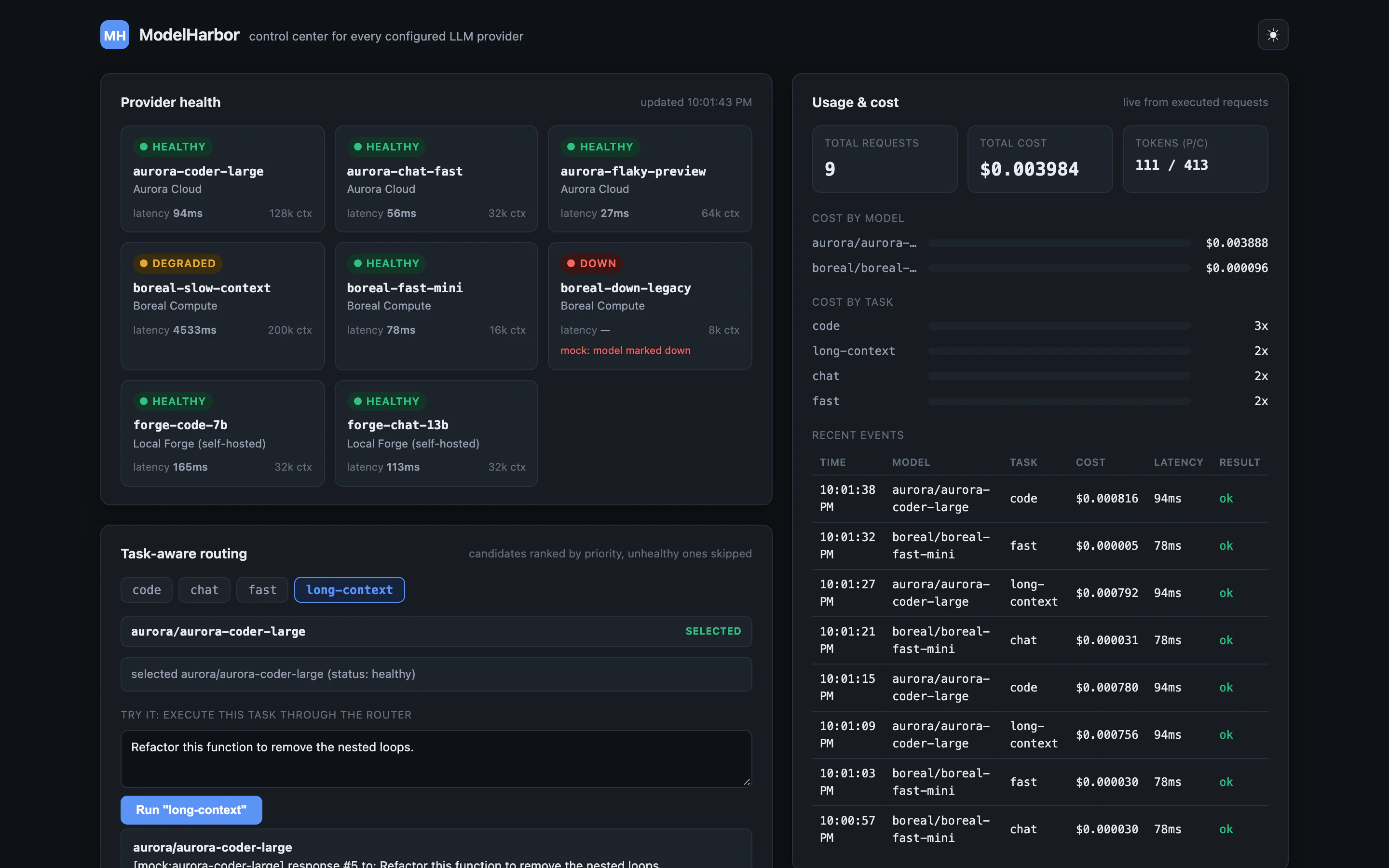
- 01Health: every configured model is checked on a TTL and classified healthy, degraded or down by latency, with the error surfaced when a check fails.
- 02Routing: each task type (code, chat, fast, long-context) has a ranked candidate pool; the router picks the highest-priority healthy model.
- 03Execution: if the chosen model's call fails, the request fails over live to the next candidate and records every attempt.
- 04Cost: every executed request, success or failure, becomes a usage event, aggregated by model, provider, task and day, optionally persisted to JSONL.
- 05Adapters for OpenAI-compatible endpoints, native Ollama and a deterministic mock used by CI and the quickstart.
04/Engineering
Deciding is separate from doing
GET /api/route answers from the health cache with no side effects, so it is safe to poll; POST /api/route is the only path that runs prompts and writes usage events.
Keys stay on the server
/api/config drops API keys and strips credentials from base URLs; provider error text has keys, bearer tokens and sk- strings replaced before it reaches the dashboard.
Unauthenticated, so local by default
The server binds 127.0.0.1, sends no CORS headers unless one exact origin is configured, requires JSON content-type on POST and rejects bodies over 1 MiB.
05/Interface
Real screenshots of the running software. Captions state the data shown.
06/Tech stack
- TypeScript
- Node.js
- Vite
- React
- Vitest
- npm workspaces
07/Result
Verified outcomes
- 144 Vitest tests with coverage gates (90% statements, lines and functions; 85% branches), per the README; a network guard fails any test that reaches a non-loopback host.
Known limitations
- The live OpenAI-compatible and Ollama adapters are tested only against stubbed fetch, not live endpoints.
- No authentication: anyone who can reach the API can spend on your providers.
08/Links
Related work
Versioned system-design workspace
ArchitectFlow →
Design a system's architecture, data model, API and UI as one versioned document, check it with deterministic rules, and generate an implementation prompt from the exact saved revision.
Open source · Experimental
Market tracker
Puffer →
A full-stack stock tracker with watchlists, market search and AI-written news digests delivered by background jobs.
Open source · In development
Agent skill · video renderer
Animation Ad →
An agent skill that reads a product's source, writes a storyboard and renders a real animated ad locally: motion graphics, characters or low-poly 3D, with voice, music and captions.
Private · Working build
Next case study
PacketLens →