Case study 36 / 37
RepoGraph
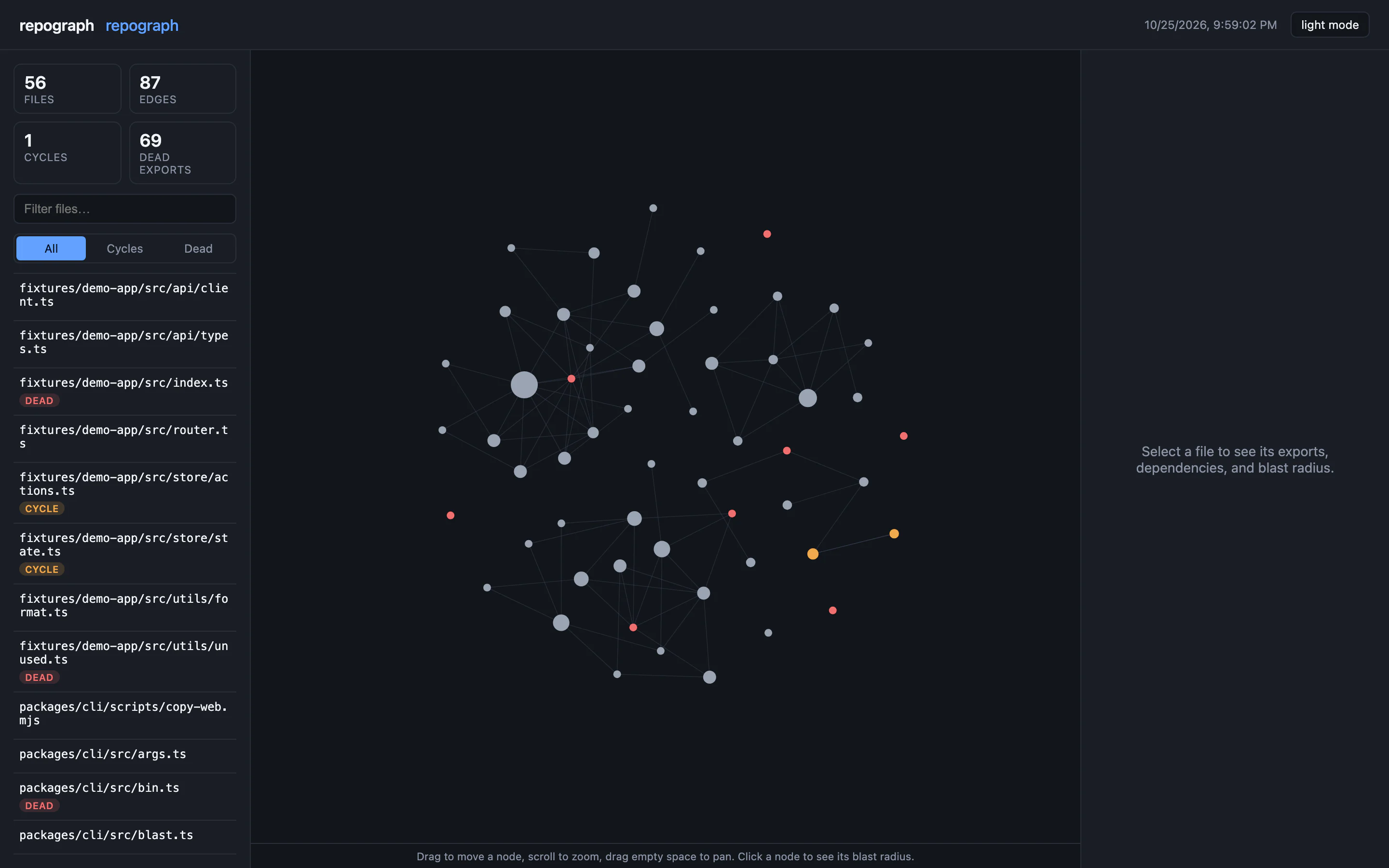
An interactive dependency map for TypeScript and JavaScript codebases: import cycles, dead exports, API surface and click-to-highlight blast radius in one HTML file.
- Status
- In development
- Period
- 2026
- Domain
- Tools
- Language
- TypeScript
- Last push
- 26 OCT 2026
- License
- MIT
- Source of claims
- README.md, CHANGELOG.md, docs/PRODUCTION_READINESS.md, fixtures/demo-app.report.txt, .github/workflows/ci.yml
01/The problem
Dependency tools either print one report (cycles, unused deps or unused exports) or draw a pretty graph with no analysis behind it. Neither answers “what breaks if I change this file?”
02/The system
An analysis engine built on the TypeScript compiler API's parser, a CLI, and a React viewer with a hand-written canvas force layout. It finds cycles with iterative Tarjan SCC, flags exports nothing imports while respecting re-exports and namespace imports, and writes the whole result as one self-contained HTML file.
03/Implementation
- 01Resolves every internal import, re-export, require() and dynamic import() to a real scanned file, with a deduplicated list of external specifiers per file.
- 02Circular dependencies as strongly connected components (size > 1) found with an iterative Tarjan's algorithm.
- 03Dead-export detection that tracks default, named, type-only, namespace imports and export * separately, and exempts declared entry points.
- 04Blast radius: every transitive dependent grouped by hop distance, plus which of the file's exports those dependents actually consume.
- 05html (one self-contained file), serve, report (exit 1 on cycles), blast and analyze (JSON) commands.
04/Engineering
Syntax only, no type checker
The parser never builds a ts.Program, so it is one fast pass per file and works on plain .js code with no tsconfig.json.
Conservative dead-code rules
A file targeted by import * as ns or export * has none of its exports flagged, trading a few missed results for fewer false positives.
Safe local serving
serve binds 127.0.0.1, rejects non-loopback Host headers to block DNS rebinding, and the scanner skips symlinked directories and outside-root symlinked files.
05/Interface
Real screenshots of the running software. Captions state the data shown.
06/Tech stack
- TypeScript
- TypeScript compiler API
- React
- Vite
- Canvas
- Vitest
- npm workspaces
07/Result
Verified outcomes
- CI on Ubuntu, Windows and macOS (Node 20 and 22) asserts the CLI's report against the bundled fixture byte for byte.
Known limitations
- No tsconfig paths or bundler alias resolution; no cross-package resolution in monorepos.
- Not published to npm; the npm package of the same name is an unrelated project.
08/Links
Related work
Agent skill · video renderer
Animation Ad →
An agent skill that reads a product's source, writes a storyboard and renders a real animated ad locally: motion graphics, characters or low-poly 3D, with voice, music and captions.
Private · Working build
Configuration linter
dotenv-doctor →
Validates .env files against the committed .env.example and catches the configuration mistakes that otherwise only show up after a deploy.
Open source · Released
Readable packet inspector
PacketLens →
A packet inspector that decodes Ethernet, IP, TCP, UDP, DNS and TLS, tracks connections, and explains each flow in one plain-English sentence.
Open source · In development
Next case study
Waterfall Lens →