Case study 37 / 37
Waterfall Lens
Turns a HAR capture into an answer: the critical rendering chain, connection queuing and third-party weight, explained in plain English beside an interactive waterfall.
- Status
- In development
- Period
- 2026
- Domain
- Web · Tools
- Language
- TypeScript
- Last push
- 26 OCT 2026
- License
- MIT
- Source of claims
- README.md, CHANGELOG.md, docs/PRODUCTION_READINESS.md, src/analyze.ts, test/hostile-input.test.ts, .github/workflows/ci.yml
01/The problem
DevTools already draws a waterfall. What it does not say is why first paint was slow and whose fault it was. A page can make 80 requests while only three gate first paint.
02/The system
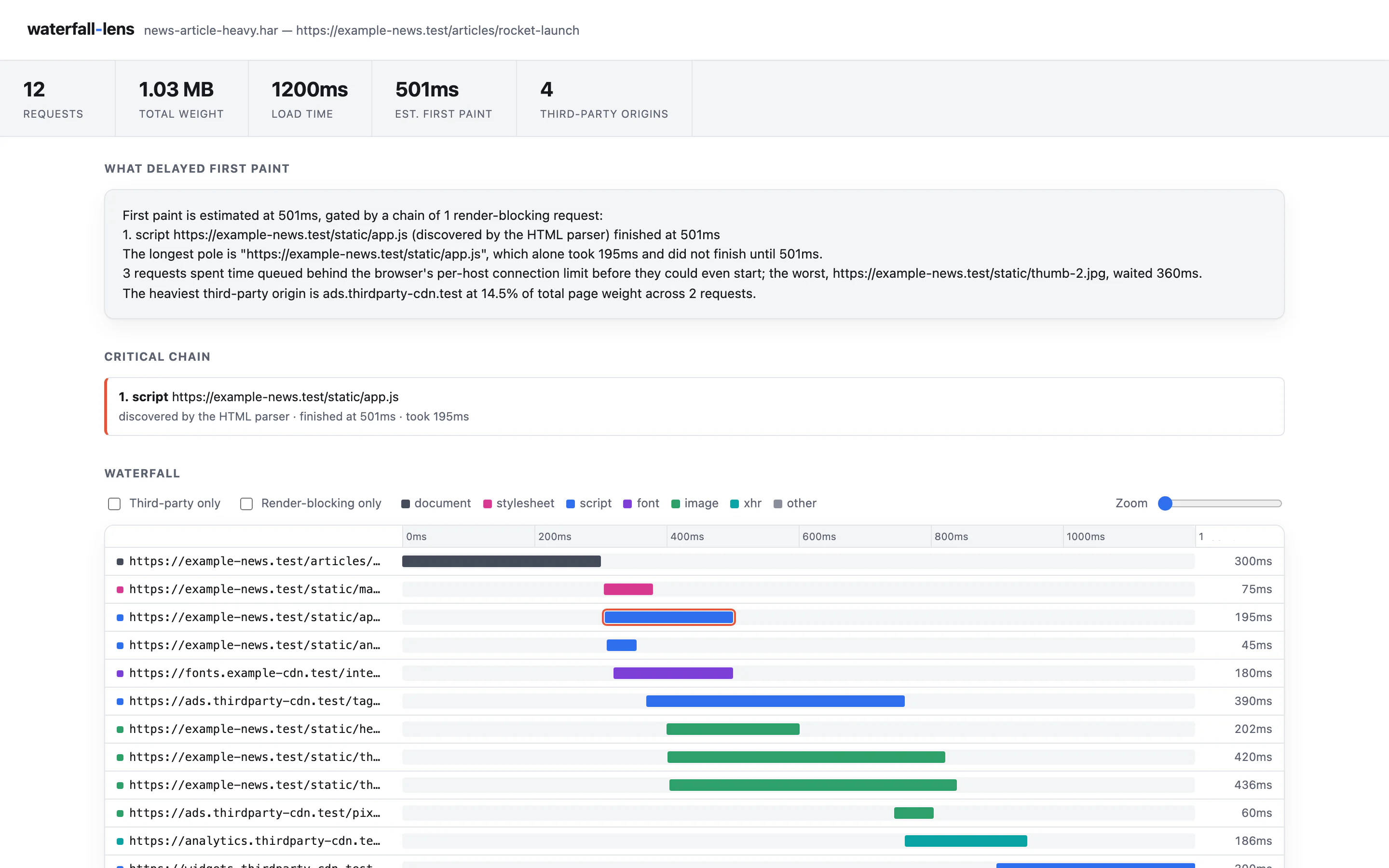
A TypeScript CLI and library. A pure analysis function walks real initiator links back from the last render-blocking response to the navigation request, separates time spent queued for a connection from network time, and attributes page weight to third-party origins. The report is one self-contained HTML file that works from file://.
- parser.ts to normalizeEntries
- normalizeEntries to buildCriticalChain
- normalizeEntries to Third-party weight
- normalizeEntries to Queued requests
- buildCriticalChain to cli.ts
- buildCriticalChain to html.ts
03/Implementation
- 01Structural HAR validation with clear errors for truncated or non-HAR JSON.
- 02Entry normalisation: resource type, timings relative to navigation start, third-party and render-blocking flags.
- 03Critical chain built by walking _initiator links backward from the latest-finishing render-blocking response.
- 04Queued-request detection that separates connection-slot waiting (blocked time with no DNS, connect or TLS) from genuinely slow responses.
- 05Third-party weight grouped by host, and a plain-English explanation of all of the above.
04/Engineering
A heuristic, labelled as one
HAR has no async/defer metadata, so a script counts as render-blocking only when DevTools recorded it as parser-discovered. This is documented in the source and not presented as a browser simulation.
Engine without I/O
analyze.ts is a pure Har → WaterfallReport function, so most tests run against hand-built HAR shapes.
HAR strings are untrusted
The report inserts every HAR string as escaped text and escapes < in embedded JSON; a test renders HTML and script payloads in URLs and checks nothing executes.
05/Interface
Real screenshots of the running software. Captions state the data shown.
06/Tech stack
- TypeScript
- Node.js 20+
- HAR 1.2
- Vanilla JS report
- Vitest
- GitHub Actions
07/Result
Verified outcomes
- 118 Vitest tests with enforced coverage thresholds, run by CI across Node 20/22 on Ubuntu, Windows and macOS (per the README).
- Reported in the README (one run, Apple M5): a synthetic 20,000-entry capture analysed in about 0.2 s by the CLI.
Known limitations
- Render-blocking classification is a heuristic; the whole HAR is read into memory.
- The report's initiator lookups are quadratic in the number of entries.
08/Links
Related work
Documentation engine
DocAtlas →
A documentation site engine whose cross-references cannot go stale: live code includes from the real source tree, dead links that fail the build, and BM25 search.
Open source · In development
Versioned system-design workspace
ArchitectFlow →
Design a system's architecture, data model, API and UI as one versioned document, check it with deterministic rules, and generate an implementation prompt from the exact saved revision.
Open source · Experimental
Agent skill · video renderer
Animation Ad →
An agent skill that reads a product's source, writes a storyboard and renders a real animated ad locally: motion graphics, characters or low-poly 3D, with voice, music and captions.
Private · Working build
Next case study
DataJewellers →